I Love YoU More Than Applesauce
By Jack Prelutsky
I love you more than applesauce
Than peaches and a plum
Than chocolate hearts
Cherry tarts
And strawberry bubble gum
I love you more than lemonade
And seven layer cake
Than lollipops, candy drops
And thick vanilla shake
I love you more than marzipan
Than marmalade on toast
For I love pies of any size
But I love you the most

New Zeland´s GLowWorm
A glowworm is the larvae stage in the lifecycle of a two-winged insect.

There are many different types of glowworm, but the one in New Zealand is Arachnocampa luminosa. 'Arachno' means spider-like, in reference to the way glowworms catch flying insects like spiders do and 'campa' means larva and 'luminosa' means light-producing.
The glowworm can control its glow by reducing the oxygen to the light organ. Insects fly towards the light and get stuck in the sticky lines produced by the glowworm saliva!
Here are pictures of a larvae and an adult
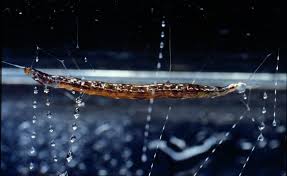
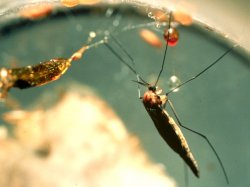
Here are pictures of a larvae and an adult
A glowworm uses its light to attract food and to burn off its waste. It is bioluminescence, a reaction between the chemicals produced by the glowworm and the oxygen in the air, what makes its tail shine.
Glowworms can survive only in very wet, dark places where their light can be seen.
They need a fairly horizontal ceiling from which they can hang their sticky feeding lines and shelter from the wind, so the lines don´t get dry out or tangled.

The Waitomo cave, a 30 million year old Oligocene limestone sinkhole, provides an abundance of insects brought into the cave via the river.

The Waitomo Glowworm Caves were first explored in 1887 by local Maori Chief Tane Tinorau accompanied by an English surveyor Fred Mace. Waitomo is a Maori word made up of 'Wai' (water) and 'tomo' (entrance or hole).
The KiWi Bird: New ZeaLand´s Endemic Species
This 8 million years old bird has a beak that is one third of the lenght of its body and it hasn´t got a tail.
Also the female is larger than the male and they mate for life

The Māori believed that kiwi were under the protection of Tane Mahuta, god of the forest.
Birds were eaten and their feathers were used for ceremonial cloaks
The kiwi bird lays enormous eggs which can be up to half the weight of the bird!


Al Di MeoLa, John McLaughlin & Paco de Lucía
"Morning Of The CarnivaL"
Al Di Meola (Born July 22, 1954) is an American Jazz Fussion/Latin Jazz Composer and Guitarist
John Mc Laughlin (Born July 4, 1942) is an English Composer/Guitarist and Band Leader
Paco de Lucía (1947-2014) was a Spanish Virtuoso Flamenco Guitarist/Producer and Composer


The Carnival of Venice: Violin
The Carnival of Venice, is a folk tune associated with the words
"My hat, it has three corners"


Subscribe to:
Posts (Atom)