


SuN CitY, SouTH AfricA
The world’s largest thematic resort hotel in the world – The Palace of the Lost City – is in South Africa.
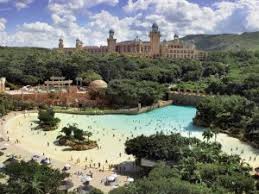
Surrounding the Palace is a 25 hectare manmade botanical jungle with almost 2 million plants, trees and shrubs.
CLick Here to Check it Out!
Surrounding the Palace is a 25 hectare manmade botanical jungle with almost 2 million plants, trees and shrubs.
CLick Here to Check it Out!

South Africa´s Re-Breeding Project: Extinct Quaggas
The Quagga, a uniquely South African animal that inhabited the Karoo and southern Free State was hunted to extinction in the late 1800´s by colonists, who considered the species as competitors for their grass-eating sheep, goats and livestock.

| "The extermination of the Quagga" Franz Roubal 1931 |

SouTH Africa´s Endemic Birds: Southern Bold Ibis
The scientific name of this bird Geronticus calvus means bald, old man; it refers to its bare head and wrinkled skin, on its face and neck.


Boer farmers shot this ibis during the South African wars, to supplement their meat supplies and settlers hunted it for both food and its feathers.
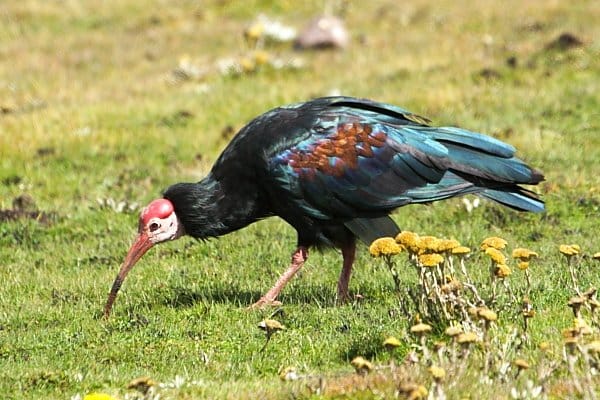
This bird makes a weak gobbling sound, so old Afrikaans named it wild turkeywilde-kalkoen .
The Southern Bold Ibis has always been hunted by humans! Young birds were used by the Zulu natives as medicine.
South Africa´s: Long Tailed Cape SugarBird
These birds are common or endemic in and around Cape Town, Cape Point National Park and Kirstenbosch Botanical Gardens.
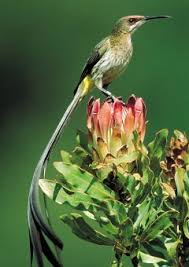
The male long tailed Cape SugarBird.

And the female.
A characteristic of the Cape Sugarbird is the sound it makes when it flies: when the bird beats its wings, a frrt-frrt sound is made to attract the females...
The male long tailed Cape SugarBird.
And the female.
A characteristic of the Cape Sugarbird is the sound it makes when it flies: when the bird beats its wings, a frrt-frrt sound is made to attract the females...
Kimberley: South Africa´s First Diamond Mine

The Kimberley Diamond Mines known worldwide are located in the town of Kimberley, South Africa. In 1866 Erasmus Jacobs discovered a small stone by the Orange River, it was the first South African diamond!

When diamonds are still not cut or polished they are called rough diamonds and can be found in octhahedra, cubic, macle, and dodecahedron crystal shapes.

An octahedra has got eight faces and is the most common form of a rough diamond. A cube shape is like a simple box. A macle is pyramid shaped. A dodecahedron has a rounded shape with many different types of flat faces on it: a perfect one will have 20 triangular faces, 30 square faces and 12 pentagonal faces!
School´s Music lessons with The Jackson 5 ABC song
The King of SouL: Sam CooKe "Wonderful World" of SchooL
South Africa´s NationaL AnimaL: The Springbok

They can run as fast as 97 kilometres per hour (60 miles per hour) and can leap 4 metres (13 feet) into the air and long jump up to 15 metres (50 feet).
View videos of the Springbok: (Antidorcas Marsupialis). CLick Here!
Our Lineage: The San PeopLe, Kalahari desert South Africa
A group of researchers have found tools in Border Cave, South Africa, which are very similar to those still in use today by the african San culture.

San rock paintings
The Kalahari Desert covers most of Botswana, northern South Africa and eastern Namibia. The desert's name comes from the Tswana word Kgalagadi, meaning "the great thirst."
South Africa and the Human Family Tree: The TaunG Child
Human origins fossiL evidence. CLicK

In 1924, Raymond Dart an Australian anatomist and anthropologist, discovered the first fossil ever found of Australopithecus africanus, anextinct Hominid closely related to humans at Taung, South Africa. Because he was not part of the scientific establishment and found the fossil in Africa and not Europe or Asia (man´s supposed origins), his findings were initially rejected.
The following video shows which" modern" characteristics in the Taung child made him revolutionary.
In 1924, Raymond Dart an Australian anatomist and anthropologist, discovered the first fossil ever found of Australopithecus africanus, an
Raymond Dart and the Taung child skull
| |
Fossilized Footprints...
How do we know if an early
ape-man or womanwalked upright? An examination of certain bones - a tibia (leg bone) or a pelvis-, can reveal the answer and so can fossilized footprints.In 1976, members of a team led by Mary Leakey discovered the fossilized footprints ofhuman ancestorsin Laetoli, Africa formed 3.5 million years ago when at least two individuals walked over wet volcanic ash, that hardened like cement and was then covered by more ash.
The footprints show that one hominid was larger than the other and because the footprints fall next to each other, that they were walking side by side and close enough to each other to be touching.
Apes sometimes walk on two legs. How, then, can we be sure that the footprints weren't left by a couple of apes that decided to walk upright for a few yards? When an ape walks upright, weight is transmitted from the heel, along the outside of the foot, and then through the middle toes. A human foot transmits weight from the heel, along the outside of the foot, across the ball of the foot, and finally through the big toe (this is a much more efficient way to transfer energy when walking upright).
The footprints look remarkably like a human and some scientists had a hard time believing that they were made by Australopithecus afarensis (Lucy's species), the only human ancestor known to have lived at the time.
S. Africa´s CoaT of Arms
 |
| "Diverse People Unite" |
Its central image is a Secretary bird with a sun rising above it.
Below the bird is the Protea, an indigenous flower.
At the centre stands a shield above which are a spear and knobkierie.
Subscribe to:
Posts (Atom)