Jack Frost


AURORAS


The Aurora Borealis or Northern Lights were named by the French scientist, Pierre Gassendi, in 1621. They were named Aurora for the  Roman goddess of the dawn (known as Eos and usually described as "rosy-fingered" by the Greeks) and for the god of the North wind  Boreas in Latin. 

The colour spectrum of the Northern lights is determined by the gases with which the particles from the sun collide and by the altitude at which the collision takes place in the atmosphere. 

These are examples of the Auroras Borealis or  Northern lights which occur from 90 km to approximately 150 km above the Earth's surface. The colours can be categorised more or less as follows:

  • More than 150 km: Red light
  • 120 km - 150 km: Yellow-Green light
  • Less than 120 km: Blue-Purple light
    And  the Coronal Auroras.

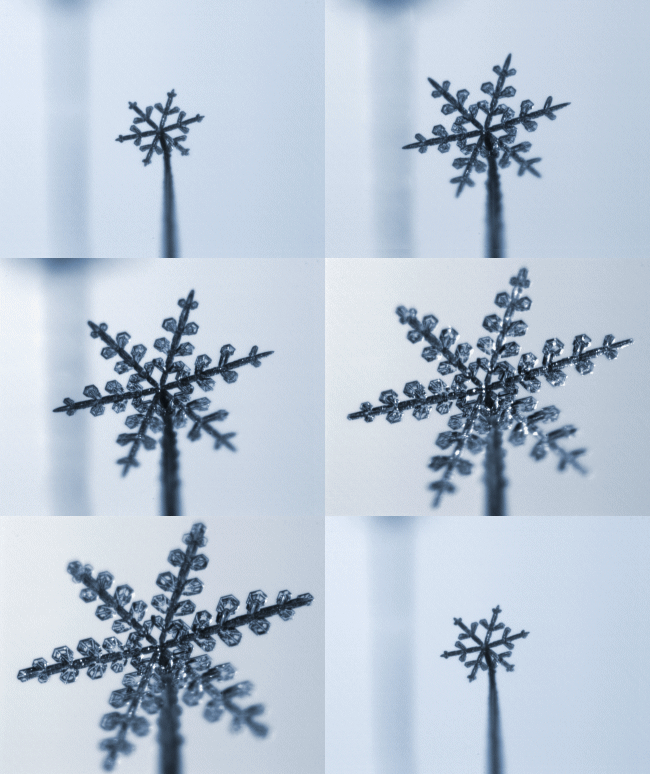
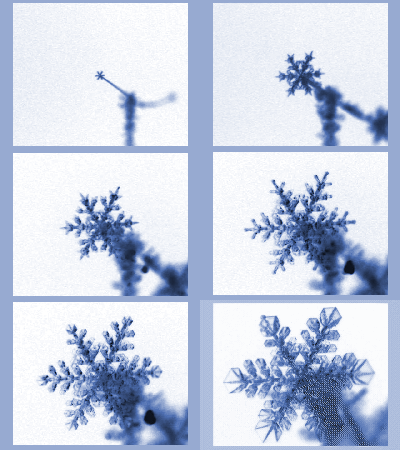
Watch Snowflakes grow!

Please Come Back This Year!

Santa Claus Got Stuck in my Chimney
Bujujuju Bujujuju
Poor Me!

Santa Claus got stuck in my chimney,
Stuck in my chimney, stuck in the chimney
Santa Claus got stuck in my chimney
When he came last year


Poor Santa Claus!

Santa Claus got stuck in my chimney,
Stuck in my chimney, stuck in the chimney
Santa Claus got stuck in my chimney
He won't  come back, I fear

Bujuuu

There he was in the middle of the chimney
Roly-poly, fat and round

There he was in the middle of the chimney
Not quite up and not quite down

Santa please come back to my chimney
Back to my chimney, back to my chimney
Santa please come back to my chimney
You can come back here.


Cause daddy, made a brand new chimney
Just for you this year!


Santa Claus come on down the chimney,
Please come back this year!
Santa Claus Got Stuck In My Chimney
Written by William D.Hardy, Billy Moore, Jr.

Teddy Rock: Time Warp Song


ReaL SnowFlakes & SnowCrystals!


CLicK to sEE IncredibLe Photos!


See more at SnowCrystals.com

Here comes Suzy SnowFlake!


Here comes Suzy Snowflake
Dressed in a snow white gown
Tap, tap, tapping at your window pane     
To tell you she's in town.

Here comes Suzy Snowflake
Soon you will hear her say
"Come out everyone and play with me      
I haven't long to stay.

If you want to make a snowman
I'll help you make one: one, two, three      
If you want to take a sleigh ride
The ride's on me."


Here comes Suzy Snowflake
Look at her tumbling down
Bringing joy to every girl and boy      
Suzy's come to town. 


Suzie's coming...

Here comes Suzy Snowflake
Dressed in a snow white gown
Tap, tap, tapping at your window pane           
To tell you she's in town.

Here comes Suzy Snowflake
Soon you will hear her say
"Come out everyone and play with me
I haven't long to stay.


Here comes Suzy Snowflake
Soon you will hear her say
"Come out everyone and play with me
I haven't long to stay.


If you want to make a snowman
I'll help you make one: one, two, three
If you want to take a sleigh ride
The ride's on me."


Here comes Suzy Snowflake
Look at her tumbling down
Bringing joy to every girl and boy
Suzy's come to town.

South Africa´s Butterflies: Red BLood and Dusky Acrae


Their wings can measure between  45–48 mm in males and 45–55 in females.

The Dusky Acraea (Acraea esebria) has the same wingspan as the Red BLood.


Kew Gardens (London) Marianne North Gallery: South Africa

Marianne North (24/10/1830 – 30/08/1890) was an English Naturalist and Botanical Artist who visited South Africa in 1883.

Haemanthus and other South African Flowers
(Haemanthus, Erythrina, Pineapple Flower, Eucomis punctata Tulbaghia alliacea, Haemanthus magnificus, Coral Tree)

"Coming out" of a Cape Beauty (Ostrich)
View of the valley of Ceres, from Mitchell's Pass,
View of the valley of Ceres, from Mitchell's Pass, "Cabbage Plant" in front
(Othonna Compositae Othonna amplexocaulis)

Cape Town´s GIANT Cockroach


Unusually for insects, it gives birth to 18–24 live creatures and it even protects the young for a while.
When scared, it lifts its abdomen into the air, squeaks loudly and lets go a nasty smelling liquid from glands on its back.

Adult females can be from 30 to 40 millimetres and they have no wings! Males are a bit smaller: 29 millimetres long. 

Cape Floral Kindgdom: Duvalia Inmaculata


This succulent, blooms in mid-June and grows in light shade. It needs little water and is also found in the Little Namaqualand region.

The Cuckoo Wasp: South Africa

Parasites of solitary bees and wasps.

These insects spread mostly in terrestrial habitats and will roll up into a ball in self-defence.

Here is a close up of its body surface.

A Fall Song


Golden and red trees.
Nod to the soft breeze.
As it whispers: ¡Winter is near!
And the brown nuts fall.
At the wind´s loud call.
For this is the Fall of the year.

By Ellen Robena Field

South African Cartoonist: Caroline Vos

FD6550414714 by Caroline Vos

Amazing South African Athletes

In 2004 she became the first woman to climb the East face of the Central Torres del Paine in Patagonia (Chile).
In February 2005 she climbed the "Compressor" route on Cerro Torre. 

South African Rock Climber: CLICK to WATCH a VIDEO about Marianne Pretorius
On 21 August 2005 Marianne Pretorius, accompanied by Peter Lazarus, James Pitman and Andreas Kiefer reached the top of Trango Tower in Pakistan, becoming the third woman to step on the summit.

Willi Besters: South African Artist & Sculptor

Willie Bester’s eco-friendly artwork 1
His works are collages assembled from scraps and junk from flea markets and townships like shoes, bones, tins, newspaper clippings and metal pieces combined with oil paints and photographs.
Willie Bester
His father was Xhosa and his mother was classified coloured by the Apartheid system. 
When he was 10 years old his family was force to move in accordance with the Group Areas Act and Besterhad to leave school to help the family economically.
One of his works was sold for £10.000 at a Sotheby´s auction in London. 

Republic of S. Africa: Knysna Woodpecker

Goldfish: South African Music (We Come Together)


South Africa´s Sarpa Salpa Fish


Etymology: Sarpa: Spanish, sarpo, sapo = toad (a toad-fish)
Salema Porgy: This fish was consumed during the Roman Empire as a recreational drug, because it produces hallucinations! 
It is presently believed that the fish ingests a particular algae or phytoplancton which causes it to become hallucinogenic.